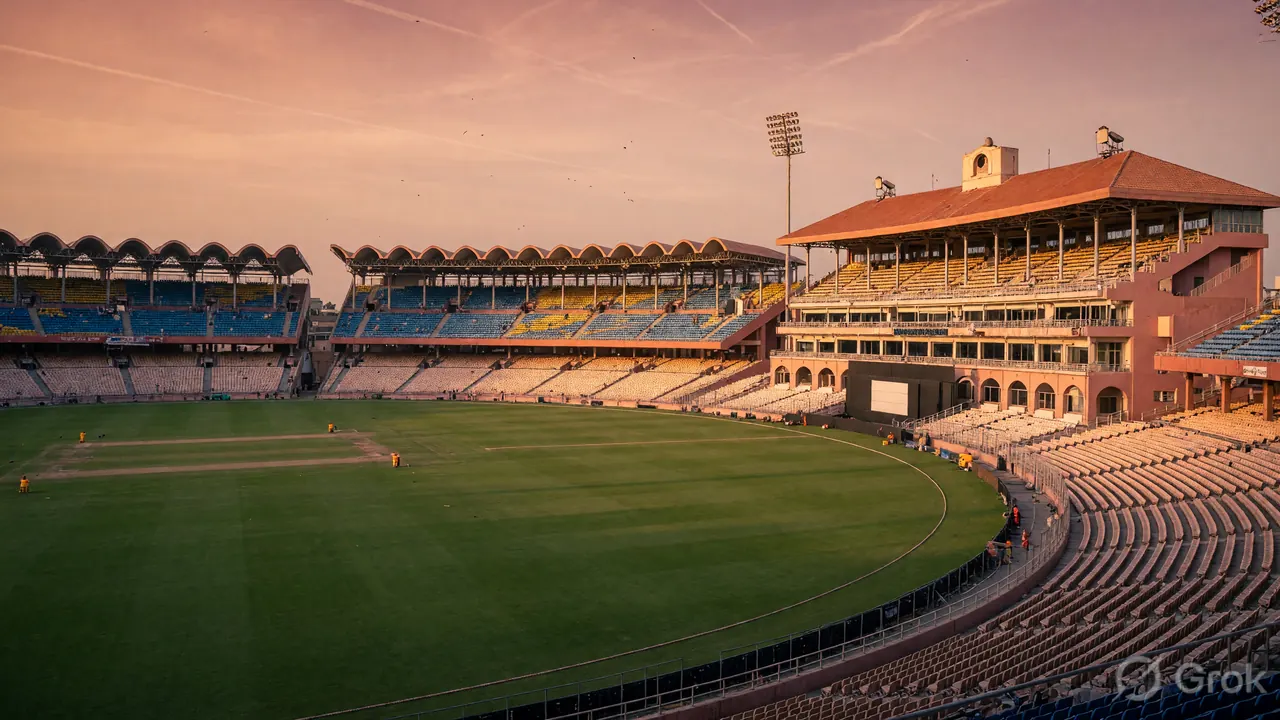
At 5:31 PM IST on 28 March 2024, Cricket Country published a Dream11 match preview for the IPL 2024 fixture between Rajasthan Royals and Delhi Capitals at Jaipur. The piece ran about two hours before the 7:30 PM IST start. It named Yashasvi Jaiswal as the suggested captain pick and Mitchell Marsh as the vice-captain, published both probable XIs in full, and closed with a single paragraph of pitch note drawn from the Royals' previous match against Lucknow Super Giants four days earlier. That is the published record.
The reason the preview is worth reading in 2026 is not the captain pick. The reason is that it is now a record of what a 12-hour pre-match fantasy preview used to contain. A modern fantasy desk publishing the same fixture in 2026 would attach four tools to that core structure — powerplay projections, impact-player reads, expected-points tables, and a venue scoring index. None of those four were in the 28 March 2024 preview. Reading the preview as a dated artifact, and reading it against what a current preview looks like, is the more interesting story than the captain pick on its own.
What the 28 March 2024 preview actually contained
Stripped to its parts, the published preview contained four blocks of editorial work. A venue-and-kickoff line. A captain pick with a vice-captain pick. Two probable XIs in full, in published batting order. A one-paragraph pitch note sourced from the same venue's previous fixture. That is the entire published structure.
The captain pick was Jaiswal, with Marsh as vice-captain. The full suggested Dream11 XI in published batting order was Jos Buttler, Sanju Samson, Yashasvi Jaiswal (C), Mitchell Marsh (VC), Shai Hope, David Warner, Axar Patel, Riyan Parag, Yuzvendra Chahal, Trent Boult and Kuldeep Yadav. That eleven sat across both probable XIs: five names from the Royals, six from the Capitals. The Royals probable XI was Jaiswal, Buttler, Samson (C), Parag, Shimron Hetmyer, Dhruv Jurel, Ravichandran Ashwin, Sandeep Sharma, Avesh Khan, Boult and Chahal. The Capitals probable XI was Warner, Marsh, Hope, Rishabh Pant (C), Ripal Bhui, Tristan Stubbs, Axar Patel, Sumit Kumar, Kuldeep Yadav, Ishant Sharma and Khaleel Ahmed.
The pitch note ran to a single paragraph. The Royals had posted 193 for 4 and restricted Lucknow to 173 for 6 at the same venue four days earlier, winning by 20 runs. From that scorecard the preview drew its surface read: consistent bounce, little help for fast bowlers, both batting line-ups expected to find the surface conducive to high scores. That paragraph is the entire pitch analysis in the published piece.
What was missing from a 2026 desk's point of view
Read against a 2026 fantasy-desk standard, four tools are absent from that structure. None of them is exotic. All four are now routine in match previews published six to twelve hours before a toss. Walking through them makes the dated quality of the 28 March 2024 preview concrete.
The first missing tool: a powerplay projection
A current fantasy preview typically ships with a powerplay projection for both innings. Six-over scorecard bands — under 45, 45 to 55, 55 to 65, over 65 — with the venue's average powerplay runs and a per-fixture adjustment for the batting line-up's T20 powerplay record. A 2026 fantasy reader is taught to read those bands before the toss; a band pick will then change captain picks, vice-captain picks, and the bowling allocations inside the XI.
The 28 March 2024 preview did not contain any of that. The pitch note said the venue had offered consistent bounce in the previous match, but did not break the previous match into powerplay versus middle versus death. A modern preview would have noted that the Royals had gone at roughly 8.5 an over in the powerplay against Lucknow and would have read that figure as a benchmark for the Capitals powerplay. The published preview leaves that work to the reader.
The absence matters because the captain pick reasoning changes if the powerplay projection changes. A batting-friendly surface that delivers a 60-plus powerplay score makes the Jaiswal captaincy cleaner, because his role is to convert powerplay tempo into a 35-plus opening stand. A 45-or-under powerplay projection, with the same surface note, would tilt the captain pick toward a middle-overs accumulator who can rebuild an innings. The published preview takes the optimistic reading by default.
The second missing tool: an impact-player read
The second routine tool a 2026 preview would carry is an impact-player read for each side. The impact-player rule, in the form it took from IPL 2023 onwards, lets a franchise substitute one player from a list of four at any point in the innings. A modern preview names the four, picks the most likely substitute at this venue, and reads that choice into the batting-versus-bowling balance.
The 28 March 2024 preview did not name impact players. Both probable XIs ran to eleven names each, with no mention of a twelfth. A modern preview would have flagged that the Royals' likely impact slot was the seam-bowling all-rounder option, and that the Capitals' most likely impact substitute was either a fifth seamer or a back-up wristspinner depending on the surface. That work is now standard; the published record skipped it.
For a fantasy reader building a XI from this preview, the gap is real. Picking both wristspinners — Chahal and Kuldeep Yadav — assumes that neither side substitutes a third seamer in. If the Capitals substitute a fourth seam option, Kuldeep's role is reduced and the captain pick on Marsh becomes more important to absorb that loss. The published preview does not run that branch.
The third missing tool: an expected-points table
A 2026 fantasy preview typically ships with a per-player expected-points table, usually in a simple grid — projected runs, projected wickets, projected catches, projected captaincy multiplier — that lets the reader see where each pick's points are expected to come from. Captaincy and vice-captaincy multipliers are listed explicitly, so a reader can compare a 1.5x versus 2x multiplier on the same player.
The 28 March 2024 preview did not include any expected-points breakdown. The reasoning for the Jaiswal captaincy was the surface read plus the Royals' form — Jaiswal had opened in the previous match and the surface was batting-friendly — but no numerical anchor was given. A 2026 reader trained on expected-points grids will read that as an absence; a 2024 reader, working from the same published record, took the captain pick at face value.
Reading the published reasoning back, the captaincy logic sits cleanly enough without a grid: a Royals opener on a batting-friendly surface against a Capitals attack short on frontline wristspin. That logic holds up under a 2026 lens. What a 2026 grid would add is the differential pick — the player whose expected points are higher than the consensus captain pick. The preview does not name a differential at all.
The fourth missing tool: a venue scoring index
The fourth tool a current preview typically carries is a venue scoring index — a venue out of ten on batting friendliness, with the season's average first-innings score, the average powerplay score, and a one-line note on whether the surface has skewed high or low against the season-to-date average. The index is a quick-glance summary; the captain pick paragraph reads against it.
The 28 March 2024 preview's pitch note functioned as a partial substitute. The Royals had scored 193 for 4 in the previous fixture, and the preview read that total as evidence of a batting-friendly surface. But it did not anchor the read against the venue's season-to-date average, did not cite the previous-match dot-ball percentage, and did not name any 2024 IPL venue index that the preview was reading against. The pitch note was a single paragraph, not an indexed view.
Reading the preview with a 2026 lens, the absence of a venue index is the most useful tell of when the preview was written. Previews from 2024 onwards at major Indian fantasy desks do carry an index, usually as a small table or a one-line caption beside the captain pick. The 28 March 2024 preview does not, and that is the clearest marker of the piece as a dated artifact rather than a current methodology document.
What the 28 March 2024 preview did right by 2026 standards
Four things in the 2024 preview still read well by 2026 standards, and they are worth marking separately from the absent tools. First, the captain pick was clearly labelled, with a vice-captain pick sitting underneath it. Second, both probable XIs were published in full, in batting order, with the franchise captaincy tag carried over. Third, the suggested Dream11 XI was published as a single named list with the (C) and (VC) tags visible. Fourth, the pitch note was sourced — it cited the same venue's previous match by scorecard, not by general impression.
Those four choices are exactly the choices a 2026 preview still makes. What has changed around them is the supporting apparatus. A 2026 preview carries a captain pick paragraph with an explicit reasoning chain; a powerplay projection band; an impact-player read; an expected-points grid; and a venue index. The captain pick itself — the named player at the top of the XI — is the same editorial decision it has always been.
The other thing the 2024 preview did well, by current standards, was hold its line on uncertainty. The preview did not name an impact player. It did not commit to a powerplay score range. It did not break out a death-overs read. Those gaps were visible to the reader. A 2026 fantasy reader trained on more apparatus would notice them; the preview did not pretend to be more detailed than it was.
Reading the captain pick on Jaiswal through the four-tool lens
Walking the Jaiswal captaincy through the four missing tools sharpens what the preview's reasoning did and did not include. Against a 60-plus powerplay projection, Jaiswal's role is the standard T20 opener's role: convert powerplay tempo into a 35-plus opening stand and force the bowlers to a third-seamer change. Against a 45-or-under powerplay projection with the same surface note, Jaiswal becomes more of a survival anchor and the captaincy moves toward a middle-overs accumulator.
Against an impact-player read that names a Royals seam-bowling all-rounder as the likely substitute, the captain pick on Jaiswal still holds: a Royals top-order batter remains the highest projected scorer regardless of whether the seam-bowling all-rounder is in the starting XI or held back as an impact option. Against a Capitals impact-player read that names a back-up wristspinner, the Kuldeep Yadav pick in the suggested XI becomes weaker, because a second wristspinner halves Kuldeep's middle-overs share.
Against a venue index that scores the surface 7 or 8 out of 10 for batting, the captain pick on Jaiswal is well-supported and the vice-captain pick on Marsh is consistent with a high-scoring chase. Against a venue index that scores the surface 5 or lower, neither captaincy pick is wrong but the upside on Marsh in particular compresses. None of those conditional branches is in the published preview. Reading them out is the work the 2026 fantasy reader now has to do on top of the 2024 published record.
Why this preview is a useful dated artifact
Two years on, the 28 March 2024 preview reads as a clean dated artifact for two reasons. First, the published structure — captain pick, vice-captain, two probable XIs, one pitch paragraph — is recognisably the same structure a 2026 preview still uses. The names change, the surface changes, the impact-player reads change, but the four-block shape persists. Second, the absence of the four supporting tools — powerplay projection, impact-player read, expected-points grid, venue index — is exactly the gap a 2026 fantasy desk would now close. Reading the preview is a useful way to see what used to be enough, and what the supporting apparatus around a captain pick has grown into.
For fantasy readers studying how previews have evolved across IPL seasons, the published record is the cleanest starting point. The 28 March 2024 preview is short enough to read in one sitting, named enough to test against the scorecard, and dated enough that its gaps are obvious rather than hidden. The longer-form view of how captain pick reasoning, impact-player math, and venue indexing have shifted across IPL 2024, 2025 and 2026 sits in the running cricket-prediction coverage tracked on cricket predictions and captain pick analysis. This note stays inside one preview and what it did and did not contain.
The captain pick on Jaiswal sits at the centre of the 2024 published record. The supporting tools a 2026 desk would now add — powerplay projection, impact-player read, expected-points grid, venue index — are the parts that have grown around the captain pick since. Reading the 2024 preview with that growth in view is the more useful retrospective exercise than re-reading the captain pick in isolation.